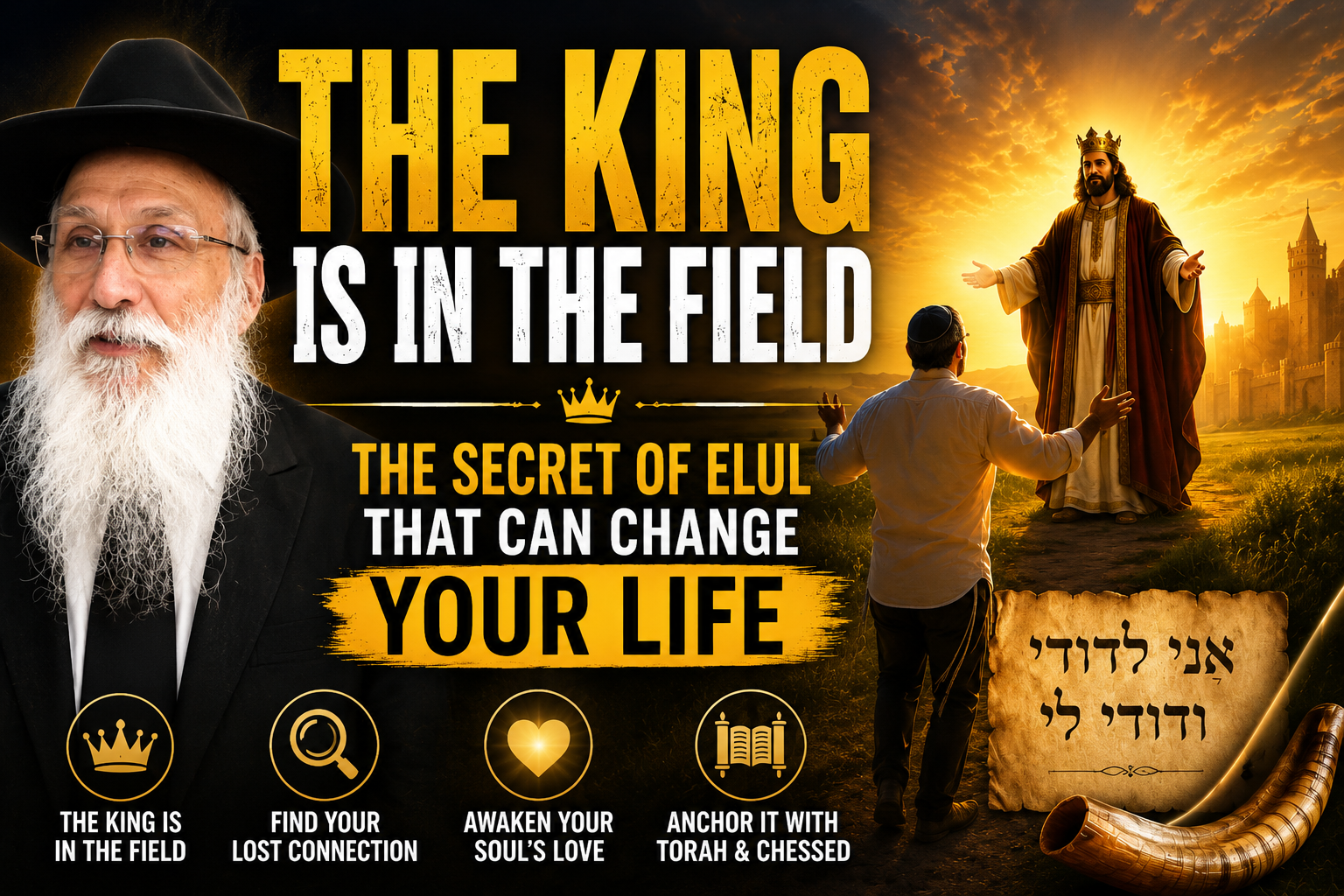
The text is a Chassidic discourse explaining the spiritual meaning of Elul, based on the verse “אני לדודי ודודי לי” — “I am my beloved’s, and my beloved is mine.”
Main idea
1. Elul is the time of “I am my beloved’s”
- Elul represents אתערותא דלתתא — a person taking the initiative to turn toward G-d.
- Rosh Hashanah and Yom Kippur represent “my beloved is mine” — the revelation of G-dliness from Above.
- During Rosh Hashanah, the emphasis is on fear and acceptance of G-d’s kingship; this continues to influence a person throughout the year.
2. The “King in the field” metaphor
The famous analogy is given of a king who is approaching his city. Before entering the palace, he is out in the field, where everyone can approach him. He receives everyone pleasantly and with a smiling face. Once he enters his palace, however, only specially selected people may enter.
This represents Elul: G-d is spiritually accessible to everyone, even to a person who feels distant.
3. The revelation of the Thirteen Attributes of Mercy
During Elul, the י”ג מדות הרחמים — Thirteen Attributes of Divine Mercy are revealed. The text explains that this revelation allows a person to awaken the deeper love and connection to G-d that already exists within the Jewish soul.
The essential point is that the Divine soul contains a Divine spark, which naturally desires to return to its source and unite with G-d.
4. “City, field, and desert”
The discourse describes three spiritual states within a person:
- City — the organized, settled aspects of one’s life.
- Field — a less developed spiritual state.
- Desert — thoughts, speech, and actions that are disconnected from G-d, including unnecessary or meaningless matters.
Elul is particularly significant because the King comes into the field—even into the places where a person may feel spiritually distant.
5. “And you shall seek G-d from there”
The verse “ובקשתם משם את ה׳ אלקיך” — “You shall seek G-d from there” means that a person must search for the lost Divine connection precisely where it has been lost.
This means examining one’s past thoughts, speech, and actions, recognizing where one has become distant, and using that recognition to return to G-d.
6. Awakening compassion for the Divine soul
If a person feels regret over his spiritual failures, he should awaken רחמים — compassion for the Divine spark within him that has been placed in a state of spiritual exile.
The discourse gives the analogy of an injured body part: when the part is still connected to the body, the brain feels its pain. Similarly, because the Jewish soul remains connected to G-d, a person’s spiritual pain should be felt as an injury to that connection.
Even when someone has become so spiritually numb that he no longer feels this pain, that itself should lead him to awaken even greater Divine compassion.
7. “If your sins are like scarlet, they will become white as snow”
The discourse then explains the symbolism of the rose/shoshana. Something red can be transformed into white through fire.
Similarly, sins and worldly thoughts are symbolically “red,” but through the spiritual fire of teshuvah, they can be transformed into purity and closeness to G-d.
8. Finding the hidden love
The text concludes with another verse:
“אבקשה את שאהבה נפשי... אחזתיו ולא ארפנו”
“I will seek the one whom my soul loves... I will hold on to him and not let go.”
The love of G-d is actually already present within the soul—it is something the soul loved from before, because Jewish souls existed in G-d’s primordial thought. Sometimes that love becomes “lost” or hidden. Elul is the time to search for it and recover it.
But discovering the love isn’t enough. It needs vessels so that it can remain revealed. Those vessels are:
- Torah Shebichtav — Written Torah
- Torah Shebaal Peh — Oral Torah
- Chesed/Tzedakah — acts of kindness and charity
The Torah and acts of kindness provide the framework through which the spiritual love can become lasting and expressed in life.
In one sentence
Elul is the month when the “King is in the field”: G-d makes Himself especially accessible, allowing a person to search within the places where his Divine connection has become lost, awaken his hidden love and compassion for his soul, do teshuvah, and then anchor that renewed connection through Torah and acts of kindness.